

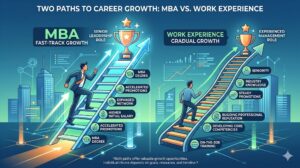
Choosing between an MBA and work experience can feel confusing. On one hand, an MBA promises structured learning, better roles, and faster growth. On the other hand, work experience offers real-world exposure, income, and skill-building from day one.
So, what actually builds better career growth?
The answer isn’t one-size-fits-all. Instead, it depends on your goals, timing, and career direction. In this guide, you’ll clearly understand when an MBA makes sense, when work experience is better, and how to combine both for maximum growth.
Table of Contents
- What Does Career Growth Really Mean?
- MBA: What It Offers for Career Growth
- Work Experience: Real-World Career Advantage
- MBA vs Work Experience: Key Differences
- When MBA Is the Better Choice
- When Work Experience Is the Better Choice
- ROI Comparison: MBA vs Job Experience
- Hybrid Approach: Best of Both Worlds
- How to Choose the Right Path for You
- Final Verdict: What Builds Better Growth?
- FAQs
What Does Career Growth Really Mean?
Before comparing, you need clarity on career growth.
Career growth is not just about salary. Instead, it includes:
- Skill development
- Promotion speed
- Industry exposure
- Leadership opportunities
- Job stability
- Long-term earning potential
So, the real question becomes:
Which path helps you grow faster, smarter, and sustainably?
MBA: What It Offers for Career Growth
An MBA is not just a degree. Instead, it is a structured transformation.
Key Benefits of MBA
- Management Skills: You learn strategy, leadership, and decision-making
- Career Switch Opportunities: Shift from technical to managerial roles
- Higher Starting Salary: Especially from Top MBA College in Delhi NCR
- Strong Network: Alumni, faculty, recruiters
- Placement Support: Direct entry into corporate roles
Quick Highlights
| Factor | MBA Advantage |
|---|---|
| Career Shift | High |
| Salary Boost | Strong |
| Leadership Roles | Fast-track |
| Networking | Excellent |
However, MBA requires time + money investment.
Work Experience: Real-World Career Advantage
Work experience teaches what books cannot.
Instead of theory, you learn through real challenges, deadlines, and decisions.
Key Benefits of Work Experience
- Practical Skills: Hands-on learning
- Income from Day 1
- Industry Exposure
- Skill Specialization
- Better Decision-Making for Future MBA
Quick Highlights
| Factor | Work Experience Advantage |
|---|---|
| Practical Knowledge | Strong |
| Immediate Earnings | Yes |
| Risk | Low |
| Career Clarity | Improves over time |
However, growth can be slow without structured learning.
MBA vs Work Experience: Key Differences
Now let’s compare both directly.
| Criteria | MBA | Work Experience |
|---|---|---|
| Learning Type | Structured | Practical |
| Cost | High | Low |
| Salary Growth | Fast (post MBA) | Gradual |
| Risk | Medium | Low |
| Career Switch | Easy | Difficult |
| Networking | Strong | Limited (initially) |
| Leadership Entry | Faster | Slower |
So, MBA accelerates growth, while work experience builds foundation.
When MBA Is the Better Choice
An MBA makes more sense in certain situations.
Choose MBA if:
- You want management or leadership roles
- You aim for high-paying corporate jobs
- You plan to switch domains (e.g., engineering → management)
- You target Top 10 MBA College in Delhi NCR
- You need structured career direction
Example Scenario
If you are confused after graduation, an MBA helps you restart with clarity.
Also, if you choose a Top Private MBA College in Delhi NCR, you get better placement exposure.
When Work Experience Is the Better Choice
Sometimes, jumping into an MBA too early can backfire.
Choose Work Experience if:
- You lack career clarity
- You want to explore industries
- You need financial stability
- You aim for top MBA colleges later
- You want real-world problem-solving skills
Example Scenario
If you gain 2–3 years of experience, you understand:
- What industry suits you
- Which MBA specialization to choose
- What skills you lack
As a result, your MBA becomes more valuable.
ROI Comparison: MBA vs Job Experience
Students often ask: Which gives better ROI?
Let’s break it down.
MBA ROI
- Fees: ₹5–20 Lakhs
- Average Salary: ₹6–15 LPA
- ROI depends on college quality
Work Experience ROI
- Investment: Zero
- Earnings: ₹2–6 LPA (initially)
- ROI grows slowly
ROI Table
| Factor | MBA | Work Experience |
|---|---|---|
| Initial Investment | High | Zero |
| Payback Time | 2–4 Years | Immediate |
| Long-Term Growth | High | Moderate |
Clearly, Best MBA College in Delhi NCR gives strong ROI. However, low-quality colleges may not.
Hybrid Approach: Best of Both Worlds
Smart students don’t choose one. Instead, they combine both.
Ideal Path
- Graduate
- Work for 2–3 years
- Pursue MBA
Why This Works
- You gain clarity
- You improve profile
- You get better colleges
- You secure higher placements
This is why many top recruiters prefer candidates with pre-MBA experience.
How to Choose the Right Path for You
You should not follow trends blindly.
Instead, ask yourself these questions:
Self-Assessment Checklist
- Do I know my career goal?
- Can I afford MBA fees?
- Do I need immediate income?
- Do I want leadership roles early?
- Am I targeting Top MBA College in Delhi NCR?
Decision Guide
| Situation | Best Choice |
|---|---|
| Confused about career | Work Experience |
| Clear goal + budget | MBA |
| Want high ROI | MBA (Top College) |
| Need stability | Job first |
| Want leadership fast | MBA |
Final Verdict: What Builds Better Growth?
Both MBA and work experience build career growth. However, they do it differently.
- MBA = Fast-track growth + leadership + salary boost
- Work Experience = Strong foundation + clarity + low risk
Best Strategy
Start with work experience. Then pursue MBA from a Top Private MBA College in Delhi NCR.
This way, you reduce risk and maximize returns.
FAQs
1. Is MBA better than work experience?
Not always. MBA is better for fast growth, while work experience builds strong basics.
2. Should I do MBA immediately after graduation?
Only if you are clear about your goals. Otherwise, gain experience first.
3. How much experience is ideal before MBA?
2–3 years is considered optimal.
4. Does MBA guarantee high salary?
No. Salary depends on college, skills, and specialization.
5. Which is better for long-term growth?
A combination of both works best.