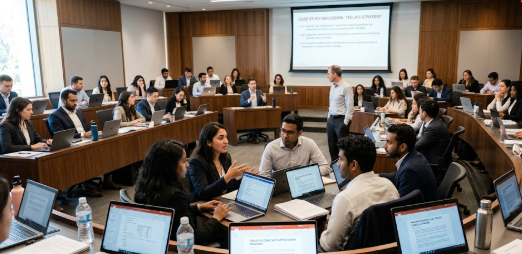


Many students start their careers by completing assigned tasks. They follow instructions, meet deadlines, and focus on execution. However, over time, they realize something important. Growth does not come from doing more tasks—it comes from making better decisions.
This is exactly where an MBA changes your career trajectory. It shifts your mindset from “What should I do?” to “What should we do next?”
If you are exploring a TOP MBA College in Delhi NCR, you are not just looking for a degree. Instead, you are investing in a mindset shift—from execution to ownership.
Table of Contents
- Introduction
- What is Task Execution vs Decision Ownership
- Why Companies Value Decision Makers
- How MBA Builds Decision-Making Skills
- Key Subjects That Drive Strategic Thinking
- Real Transformation Journey During MBA
- Skills That Shift You to Leadership Roles
- MBA vs Non-MBA Career Growth Comparison
- How to Choose the Right MBA College
- Top MBA Colleges in Delhi NCR (Comparison Table)
- Fees vs ROI: What You Should Expect
- Placement Reality and Career Outcomes
- Final Thoughts
- FAQs
2. What is Task Execution vs Decision Ownership
Let’s understand this clearly.
Task Execution
- You follow instructions
- You complete assigned work
- You depend on seniors for direction
- Your impact is limited to your role
Decision Ownership
- You analyze situations
- You take responsibility for outcomes
- You make strategic choices
- Your impact affects the business
In simple terms, execution is about “doing things right,” while ownership is about “doing the right things.”
That is why companies pay more to decision-makers, not just task executors.
3. Why Companies Value Decision Makers
Today’s companies operate in a fast-changing environment. Therefore, they need professionals who can think, adapt, and decide quickly.
Here’s why decision-makers are highly valued:
- They reduce dependency on leadership
- They solve complex business problems
- They improve efficiency and profitability
- They drive innovation and growth
As a result, organizations actively hire from a Top Private MBA College In Delhi NCR because these institutes focus on building decision-making ability, not just theoretical knowledge.
4. How MBA Builds Decision-Making Skills
An MBA is not just about studying business concepts. Instead, it is about applying those concepts in real situations.
Key Learning Methods
- Case studies based on real companies
- Group discussions and debates
- Live projects with industry exposure
- Business simulations
- Internship programs
Because of these methods, students gradually move from passive learning to active decision-making.
For example, instead of memorizing marketing theories, you will decide pricing strategies, branding approaches, and campaign execution plans.
5. Key Subjects That Drive Strategic Thinking
Every subject in MBA plays a role in shaping your decision-making ability. However, some subjects directly influence your thinking process.
Core Subjects
- Marketing Management
- Financial Management
- Business Analytics
- Operations Management
- Strategic Management
These subjects train you to analyze data, evaluate risks, and make informed decisions.
For instance, finance teaches you how to allocate resources. Meanwhile, marketing teaches you how to understand customer behavior. Together, they help you make balanced business decisions.
6. Real Transformation Journey During MBA
The transformation during an MBA is gradual but powerful.
Before MBA
- Focus on tasks
- Limited business understanding
- Fear of taking decisions
- Dependence on managers
During MBA
- Exposure to real-world problems
- Learning through case studies
- Building confidence in analysis
- Taking small decisions in projects
After MBA
- Ownership of business functions
- Strategic thinking ability
- Leadership mindset
- Confidence in high-stakes decisions
This transformation is why students prefer a Best MBA College In Delhi NCR, where exposure and practical learning are prioritized.
7. Skills That Shift You to Leadership Roles
An MBA develops multiple skills that directly push you toward decision ownership.
Critical Skills
- Analytical thinking
- Problem-solving ability
- Communication skills
- Leadership mindset
- Risk assessment
- Strategic planning
Moreover, these skills are not developed overnight. Instead, they are built through continuous practice, feedback, and real-world exposure.
8. MBA vs Non-MBA Career Growth Comparison
Let’s compare career growth paths.
| Factor | Non-MBA | MBA Graduate |
|---|---|---|
| Role Type | Execution-focused | Strategy-focused |
| Growth Speed | Slow | Faster |
| Decision Power | Limited | High |
| Salary Growth | Gradual | Accelerated |
| Leadership Opportunities | Delayed | Early |
Clearly, an MBA accelerates your transition from executor to decision-maker.
9. How to Choose the Right MBA College
Choosing the right college is critical. Not every institute focuses on decision-making skills.
What to Look For
- Industry exposure
- Case-based learning approach
- Internship opportunities
- Placement records
- Faculty with corporate experience
If you aim for transformation, then you should target a TOP 10 MBA College in Delhi NCR that emphasizes practical learning and leadership development.
10. Top MBA Colleges in Delhi NCR (Comparison Table)
Here is a simplified comparison to help you evaluate options.
| College Name | Key Strength | Average Package | Industry Exposure |
|---|---|---|---|
| IIM Rohtak | Strong academics | High | Excellent |
| IMI Delhi | Global exposure | High | Strong |
| GNIOT Greater Noida | Practical learning focus | Competitive | Strong |
| NDIM Delhi | Industry interface | Moderate | Good |
| Jaipuria Noida | Corporate connect | Good | Strong |
This table helps you identify a Top Private MBA College In Delhi NCR based on your career goals.
11. Fees vs ROI: What You Should Expect
Many students worry about fees. However, the real question should be ROI (Return on Investment).
Typical MBA Fees in Delhi NCR
- ₹5 Lakhs – ₹12 Lakhs
Expected ROI Factors
- Average placement package
- Career growth speed
- Skill development
- Networking opportunities
For example, a college with moderate fees but strong placements can offer better ROI than an expensive institute with weak industry exposure.
12. Placement Reality and Career Outcomes
Placements play a crucial role in your decision. However, you should look beyond just the highest package.
What Matters
- Average package
- Median salary
- Top recruiters
- Role offered (not just salary)
Common Roles After MBA
- Business Analyst
- Marketing Manager
- Financial Analyst
- Operations Manager
- HR Manager
Students from a Best MBA College In Delhi NCR often get roles that involve decision-making responsibilities from the beginning.
13. Final Thoughts
An MBA is not just a degree. It shifts you from following instructions to creating strategies. It moves you from executing tasks to owning decisions.
Therefore, if you want long-term career growth, leadership opportunities, and higher earning potential, an MBA becomes a powerful investment.
However, the key lies in choosing the right college. A well-structured program with strong industry exposure will accelerate your transition from executor to decision-maker.
14. FAQs
1. How does an MBA help in decision-making?
An MBA uses case studies, projects, and real-world exposure to train students in analyzing situations and making informed decisions.
2. Is MBA necessary for leadership roles?
While not mandatory, an MBA significantly increases your chances of entering leadership roles faster.
3. Which is the TOP MBA College in Delhi NCR?
Top institutes include IIM Rohtak, GNIOT, and other reputed colleges with strong placement records and industry exposure.
4. What is the average salary after MBA in Delhi NCR?
The average salary typically ranges between ₹6 LPA to ₹15 LPA, depending on the college and specialization.
5. How do I choose the Best MBA College In Delhi NCR?
Focus on ROI, placements, industry exposure, and practical learning methods rather than just rankings.