

Introduction
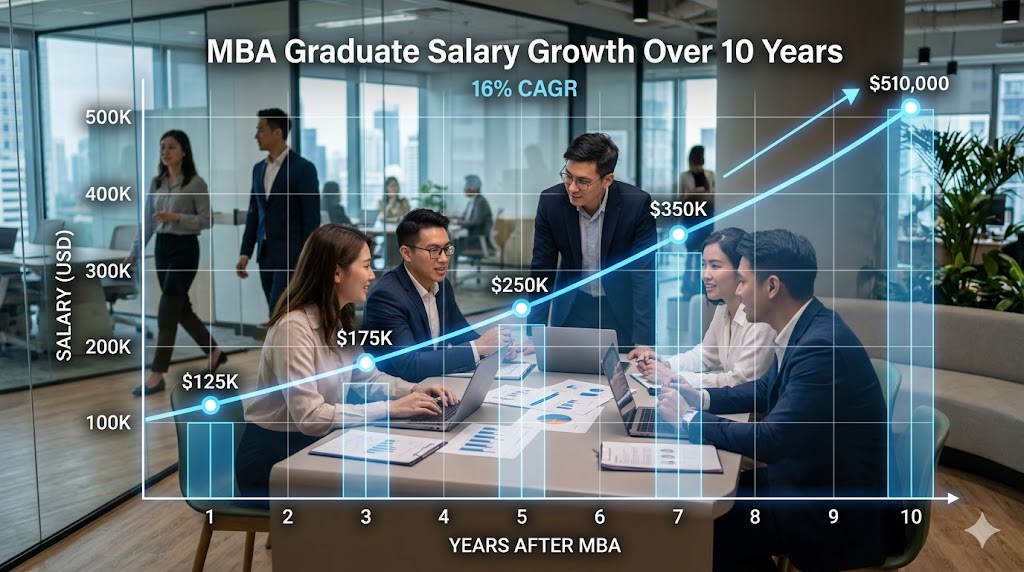
An MBA is not just a degree—it is a long-term investment that grows in value over time. At first, students often focus on placements and salary packages. However, the real impact of an MBA unfolds gradually. Over the years, the benefits compound through better roles, stronger networks, and faster career growth.
In today’s competitive job market, choosing a TOP MBA College in India or even a Top Private MBA College in India plays a crucial role in shaping this compounding effect. The right college builds the foundation, while your skills and exposure multiply the results.
So, how exactly does an MBA create this career compounding effect? Let’s break it down step by step.
Table of Contents
- What is the Career Compounding Effect?
- Why MBA is a Long-Term Career Multiplier
- Career Growth Timeline After MBA
- Skills That Compound Over Time
- MBA vs Non-MBA Career Growth Comparison
- Role of Top MBA Colleges in Career Compounding
- ROI Analysis: Fees vs Long-Term Gains
- Placement Impact on Future Growth
- Real Career Progression Examples
- How to Maximize MBA Career Returns
- Conclusion
- FAQs
1. What is the Career Compounding Effect?
The career compounding effect means that small advantages gained early in your career grow significantly over time.
For example:
- A higher starting salary leads to higher increments
- Better job roles lead to faster promotions
- Strong networks create more opportunities
So, instead of linear growth, your career moves in an upward curve.
An MBA accelerates this effect because it gives you:
- Industry exposure
- Leadership skills
- Strategic thinking ability
2. Why MBA is a Long-Term Career Multiplier
Many students think an MBA only improves their first job. However, that is only the beginning.
Here’s how it multiplies your career:
Immediate Benefits (0–2 Years)
- Higher starting salary
- Better job roles
- Corporate exposure
Mid-Term Benefits (3–5 Years)
- Promotions
- Leadership opportunities
- Role transitions
Long-Term Benefits (5–10 Years)
- Senior management roles
- Strategic decision-making positions
- Business leadership
Therefore, choosing a Best MBA College In India or one among the TOP 10 MBA College in India ensures stronger long-term outcomes.
3. Career Growth Timeline After MBA
Let’s understand how growth compounds over time:
| Years | Role Level | Salary Growth | Career Impact |
|---|---|---|---|
| 0–2 Years | Management Trainee / Analyst | Moderate | Learning & exposure |
| 3–5 Years | Manager / Consultant | High | Leadership begins |
| 5–10 Years | Senior Manager / VP | Very High | Strategic roles |
| 10+ Years | Director / CXO | Exponential | Decision-making power |
Clearly, the growth is not flat—it accelerates with time.
4. Skills That Compound Over Time
An MBA builds skills that become more valuable as your career progresses.
Key Compounding Skills
- Communication Skills
Initially useful in interviews, later critical in leadership - Decision-Making Ability
Starts small, grows into high-impact business decisions - Networking
College peers become industry connections - Strategic Thinking
Helps you move from execution to leadership
As a result, students from a Top Private MBA College in India often experience faster growth due to better exposure.
5. MBA vs Non-MBA Career Growth Comparison
Let’s compare how careers grow with and without an MBA:
| Factor | MBA Graduate | Non-MBA Graduate |
|---|---|---|
| Starting Salary | Higher | Moderate |
| Promotions | Faster | Slower |
| Leadership Roles | Early | Late |
| Career Switch | Easier | Difficult |
| Long-Term Salary | High | Limited Growth |
Therefore, an MBA gives you a clear advantage in long-term career growth.
6. Role of Top MBA Colleges in Career Compounding
Not all MBA degrees create the same impact.
A TOP MBA College in India offers:
- Strong placement support
- Industry exposure
- Corporate connections
- Skill-based learning
Similarly, a Top Private MBA College in India provides:
- Practical training
- Industry projects
- Internship opportunities
For example, institutions like GNIOT and GIMS provide industry-focused MBA programs that help students build strong career foundations.
7. ROI Analysis: Fees vs Long-Term Gains
Many students worry about MBA fees. However, ROI should be calculated over time.
ROI Breakdown
| Factor | Value |
|---|---|
| Average MBA Fees | ₹5–12 Lakhs |
| Starting Salary | ₹4–10 LPA |
| Salary After 5 Years | ₹10–25 LPA |
| Salary After 10 Years | ₹25+ LPA |
Clearly, the returns increase significantly over time.
So, investing in a Best MBA College In India is not an expense—it is a long-term investment.
8. Placement Impact on Future Growth
Placements play a crucial role in career compounding.
Why Placements Matter
- First job defines career direction
- Brand name of company adds credibility
- Salary sets future growth base
Top recruiters visiting TOP 10 MBA College in India include:
- Deloitte
- KPMG
- HDFC Bank
- Infosys
- Amazon
Therefore, strong placement support accelerates your career growth from day one.
9. Real Career Progression Examples
Let’s look at how MBA graduates grow:
Marketing Professional
- Year 1: Marketing Executive
- Year 4: Brand Manager
- Year 8: Marketing Head
Finance Professional
- Year 1: Financial Analyst
- Year 5: Finance Manager
- Year 10: CFO
HR Professional
- Year 1: HR Executive
- Year 6: HR Manager
- Year 12: HR Director
In each case, the growth compounds over time.
10. How to Maximize MBA Career Returns
Simply doing an MBA is not enough. You must use it strategically.
Actionable Tips
- Choose the right specialization
- Focus on internships
- Build strong networks
- Learn industry tools
- Develop soft skills
- Target high-growth industries
Additionally, selecting a Top Private MBA College in India with strong placement records ensures better outcomes.
Conclusion
The true value of an MBA is not visible in the first year—it reveals itself over time.
Initially, you gain better opportunities. Then, you build skills and networks. Finally, you reach leadership roles where your career growth becomes exponential.
Therefore, choosing the right college—whether a TOP MBA College in India or a reputed private institute—plays a critical role in this journey.
If you think long-term and make the right decision today, your career will not just grow—it will compound.
FAQs
1. Does an MBA really increase salary over time?
Yes, MBA graduates typically experience faster salary growth due to better roles and promotions.
2. How long does it take to see ROI from an MBA?
Most students recover their investment within 3–5 years.
3. Is MBA worth it in 2026?
Yes, especially if done from a Best MBA College In India with strong placement support.
4. Which specialization has the best growth?
Finance, Marketing, Business Analytics, and Operations offer strong long-term growth.
5. Do top colleges matter for MBA success?
Yes, colleges among the TOP 10 MBA College in India provide better exposure, placements, and career growth.