

The career landscape is evolving faster than ever. As industries shift toward data-driven decision-making, strategic thinking, and leadership agility, one thing is becoming clear—PGDM graduates are gaining strong traction across sectors.
Today, companies are not just hiring degrees; they are hiring skills, adaptability, and business awareness. This is exactly where a PGDM program stands out. If you are evaluating your career options, this guide will help you understand why industry signals strongly support PGDM as a high-growth pathway.
Table of Contents
- What Industry Trends Reveal About PGDM Demand
- Why Companies Prefer PGDM Graduates Today
- Key Skills Driving PGDM Career Growth
- PGDM vs MBA: What Industry Actually Values
- Sector-Wise Demand for PGDM Graduates
- Placement Trends Across Top PGDM Colleges
- ROI Analysis: Is PGDM Worth It in 2026?
- How to Choose the Right PGDM College
- Future Career Growth After PGDM
- Conclusion
- FAQs
What Industry Trends Reveal About PGDM Demand
First, let’s understand the bigger picture.
Over the last few years, industries have shifted from traditional hiring to skill-based hiring. Companies now prefer candidates who can solve real business problems, not just understand theory.
Key Industry Signals:
- Rise in demand for management + tech hybrid roles
- Increased hiring in consulting, analytics, and product management
- Focus on practical exposure and internships
- Preference for industry-ready graduates
Because of this shift, students from a Top PGDM College in India are getting more opportunities compared to traditional degree holders.
Moreover, recruiters now actively look for candidates trained in:
- Case studies
- Live projects
- Industry simulations
That’s exactly where PGDM programs outperform.
Why Companies Prefer PGDM Graduates Today
Now, let’s address a key question—why are companies leaning toward PGDM graduates?
The answer is simple: industry relevance.
Unlike rigid academic structures, PGDM programs update their curriculum frequently. As a result, students learn what companies actually need.
Key Reasons:
- Industry-aligned curriculum
- Strong corporate exposure
- Focus on practical learning
- Internship-driven skill development
Quick Comparison
| Factor | Traditional Degree | PGDM Program |
|---|---|---|
| Curriculum | Fixed | Industry-updated |
| Learning Style | Theoretical | Practical + Case-based |
| Industry Exposure | Limited | High |
| Placement Readiness | Moderate | Strong |
Therefore, students from the Best PGDM College in India often enter the job market with better confidence and clarity.
Key Skills Driving PGDM Career Growth
Let’s go deeper into what actually drives success after PGDM.
Because industries demand performance, not just knowledge, certain skills become critical.
High-Impact Skills:
- Business analytics & data interpretation
- Communication & leadership
- Problem-solving ability
- Strategic thinking
- Digital marketing & AI tools
Interestingly, PGDM programs actively build these skills through:
- Live projects
- Case competitions
- Industry workshops
As a result, graduates from a Top 10 PGDM College in India often adapt faster in corporate roles.
PGDM vs MBA: What Industry Actually Values
This is one of the most common doubts students have.
Let’s simplify it.
Core Difference:
- MBA → University-based (more academic)
- PGDM → Autonomous institutes (more industry-focused)
However, from a recruiter’s perspective, the focus is shifting.
What Recruiters Prefer:
- Practical exposure
- Internship experience
- Real-world problem-solving
Comparison Table
| Criteria | MBA | PGDM |
|---|---|---|
| Industry Exposure | Moderate | High |
| Curriculum Flexibility | Low | High |
| Skill Development | Moderate | Strong |
| Placement Readiness | Good | Excellent |
Therefore, many recruiters today lean toward candidates from Top Private PGDM College in India, especially those with strong internship backgrounds.
Sector-Wise Demand for PGDM Graduates
Now let’s explore where the demand is coming from.
Because industries are expanding, PGDM graduates are getting opportunities across multiple sectors.
Top Hiring Sectors:
1. Consulting
- Strategy roles
- Business transformation
- High salary growth
2. Banking & Finance
- Investment banking
- Financial analysis
- Risk management
3. IT & Analytics
- Data-driven decision roles
- Product management
- Business intelligence
4. FMCG & Marketing
- Brand management
- Sales leadership
- Digital marketing
5. Startups & Entrepreneurship
- Growth roles
- Operations leadership
- Founder opportunities
Clearly, the scope is broad. That’s why choosing the Best PGDM College in India becomes critical.
Placement Trends Across Top PGDM Colleges
Placement is where your decision becomes real.
Fortunately, PGDM colleges have shown strong placement trends over the years.
Placement Highlights (Typical Range):
- Average Package: ₹6 LPA – ₹12 LPA
- Top Roles: Consultant, Analyst, Manager
- Top Recruiters: Deloitte, EY, HDFC, Amazon, Accenture
Placement Comparison Table
| College Tier | Avg Package | Top Roles |
|---|---|---|
| Tier 1 PGDM | ₹10–20 LPA | Consulting, Product |
| Tier 2 PGDM | ₹6–10 LPA | Marketing, Finance |
| Tier 3 PGDM | ₹3–6 LPA | Entry-level roles |
Therefore, selecting a Top PGDM College in India directly impacts your starting salary and growth trajectory.
ROI Analysis: Is PGDM Worth It in 2026?
Now comes the most important question—return on investment.
Because education is a financial decision, ROI must be clear.
ROI Calculation Factors:
- Course fees
- Average placement
- Career growth speed
ROI Example:
| Parameter | Value |
|---|---|
| Fees | ₹6–10 Lakhs |
| Avg Salary | ₹7–12 LPA |
| Payback Period | 1–2 Years |
Clearly, PGDM offers strong ROI when chosen wisely.
Students from a Top Private PGDM College in India often recover their investment quickly and grow faster.
How to Choose the Right PGDM College
Choosing the right college is where most students go wrong.
However, if you focus on the right factors, your decision becomes easier.
Key Selection Criteria:
- Placement record
- Industry exposure
- Internship opportunities
- Faculty expertise
- Alumni network
Smart Decision Checklist:
- Does the college offer live projects?
- Are recruiters visiting regularly?
- Is ROI practical?
- Are students getting real corporate exposure?
If the answer is yes, you are moving in the right direction.
Future Career Growth After PGDM
Let’s look beyond placements.
Because long-term growth matters more than the first job.
Career Progression Path:
- Entry Level → Analyst / Executive
- Mid Level → Manager / Team Lead
- Senior Level → Director / VP
- Leadership → CXO roles
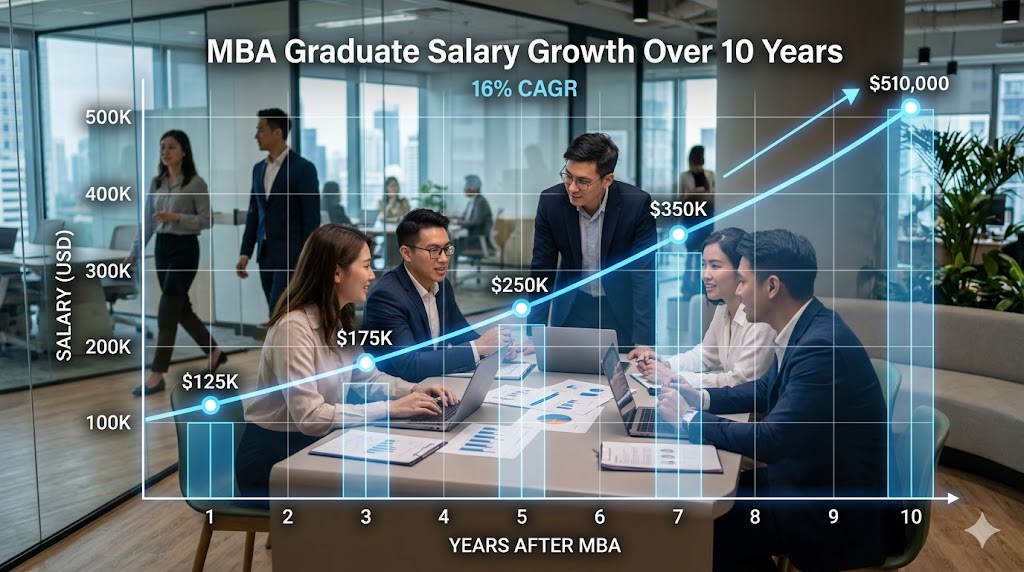
Growth Timeline:
- 0–2 Years → Skill building
- 3–5 Years → Salary jump
- 6–10 Years → Leadership roles
Therefore, PGDM is not just a degree—it’s a career accelerator.
Conclusion
Industry signals are clear and consistent.
Companies now prefer professionals who can think, act, and deliver results. PGDM programs are designed exactly for this purpose.
Because of strong industry alignment, practical exposure, and skill-focused learning, PGDM graduates are growing faster and earning better opportunities.
However, success depends on choosing the right college. If you select a Top PGDM College in India, focus on skill development, and gain real-world exposure, your career trajectory can change significantly.
In simple terms—PGDM is not just about education. It is about transformation.
FAQs
1. Is PGDM better than MBA for placements?
Yes, in many cases PGDM offers better placement outcomes because of its industry-focused curriculum.
2. What is the average salary after PGDM?
It usually ranges between ₹6 LPA to ₹12 LPA depending on the college.
3. How to choose the best PGDM college in India?
Focus on placements, ROI, industry exposure, and internship opportunities.
4. Is PGDM worth the investment?
Yes, if done from a good institute, the ROI is strong and recovery happens quickly.
5. Which sectors hire PGDM graduates the most?
Consulting, finance, IT, marketing, and startups are the top recruiters.