
The Unbuilding Economy: Strategic Management and Financial Modeling for Reverse-Engineered Material Science

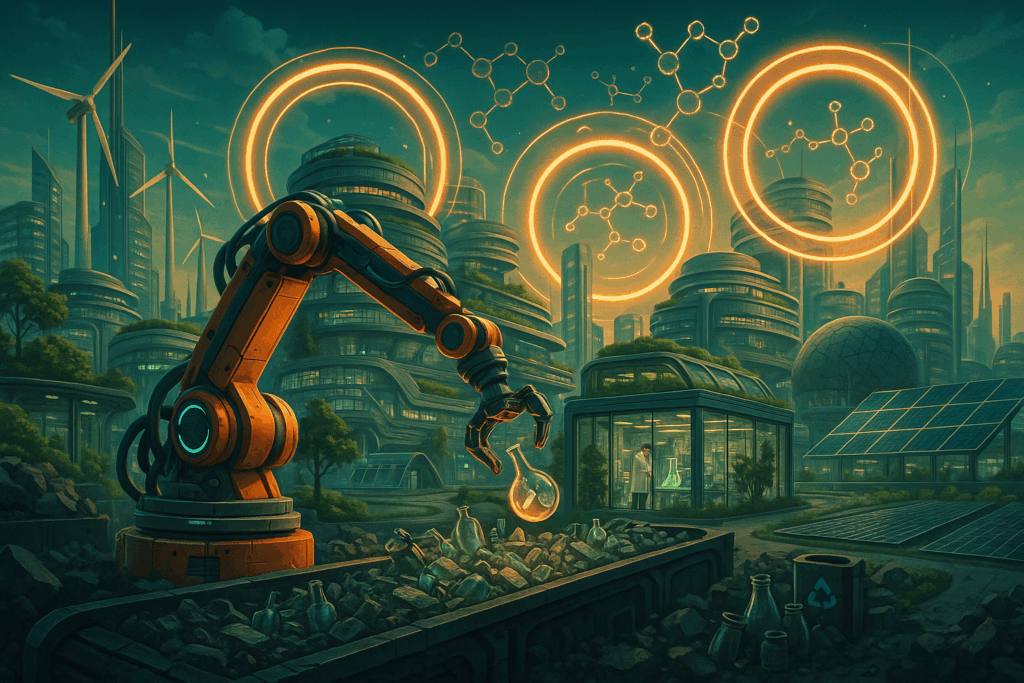
In the modern era of sustainability and advanced operations, the concept of the Unbuilding Economy Management Strategy has emerged as a transformative shift in global management thinking. As industries approach a point of material saturation, where production and consumption cycles are strained by resource scarcity, the ability to reverse-engineer existing materials has become a crucial


Read More

From VUCA to BANI: Evolving Management Frameworks for a Disrupted World

In the last decade, the world of business and management has undergone a massive transformation. What once seemed unpredictable is now completely uncertain. Every industry, from technology to healthcare, has faced continuous disruption driven by digital transformation, global challenges, and evolving consumer behavior. To prepare future leaders for this new reality, GNIOT Institute of Management

Read More

Cognitive Residency: Management and HR Strategy for the Geographically Distributed Mind-Augmented Workforce

The future of work is rapidly evolving beyond the limitations of physical presence. Traditional HR and management strategies assume that an employee’s location dictates their workspace, labor law jurisdiction, and operational efficiency. However, as neuro-augmentation and advanced cognitive enhancement technologies become widespread, a new paradigm emerges: Cognitive Residency Management Strategy. In this model, employees may

Read More

The Trust Debt Crisis: Strategic Management and Financial Cost of Repairing Algorithmically Eroded Social Capital

In the last decade, the rise of highly personalized, profit-driven algorithms has revolutionized corporate strategy, marketing, and even governance. From social media feeds and news distribution to algorithmic hiring and dynamic pricing, these systems promise efficiency and precision. Yet, beneath this veneer of optimization lies an emerging societal problem: the erosion of social trust. Individuals

Read More

Post-Labor Economics: Strategic Management of Global Operations in a World of Zero Marginal Labor Cost

The idea that labor is the primary driver of production cost has shaped global business strategy for more than two centuries. However, the era of Post-Labor Economic Strategy is approaching faster than most management models can adapt to. Once full automation replaces human labor in manufacturing, logistics, warehousing, construction, supply chain forecasting, and even administrative

Read More

The Deep-Sea Data Mining Frontier: Ethics, Governance, and Valuation of Abyssal Resource Rights

The Earth’s oceans remain one of the last unexplored frontiers, particularly the abyssal zone, lying over a kilometer beneath the surface. As technological advances in deep-sea robotics, Deep-Sea Data Mining, AI-controlled underwater drones, and materials science accelerate, previously impossible commercial ventures are now feasible. These include the extraction of rare earth minerals from hydrothermal vents

Read More

The Volcanic Mitigation Economy: Financial Modeling for Geo-Hazard-as-a-Service (GHaaS)

As Earth enters an era of accelerated climate volatility, rising tectonic instability, and unprecedented pressure on global infrastructure systems, a new economic sector is beginning to emerge—one in which geological risk is no longer simply studied, insured, or monitored, but actively managed as a purchasable service Volcanic Mitigation Economy Model. This evolving sector, known as

Read More

The Terran–Diaspora Governance Gap: Corporate Law and Tax Strategy for Inter-Planetary Organizations

Humanity is entering an age where business and governance will no longer be limited to Earth, Terran Diaspora Governance Gap. The first permanent and self-sustaining settlements on Mars, the Moon, and orbital habitats are expected to become functional within the coming decades. These colonies will not remain research outposts. Instead, they will evolve into independent

Read More

Resource Scarcity Management: Strategic Business Models for Circular Bioeconomy and Material Recoding

In today’s world, the Resource Scarcity Management Strategy has become essential for businesses striving to survive global supply challenges. Companies are rethinking how they source, recycle, and innovate within the framework of a Circular Bioeconomy. As a result, organizations are turning toward the Circular Bioeconomy, which blends advanced material science, biology, and economics. Institutions such

Read More